• About this blog

His Effing Nibs

~ In which David Brittan writes a book

His Effing Nibs

Category Archives: Tools of the trade

Battle of quills

09 Monday Nov 2015

Posted by davidbrittan in Tools of the trade

≈ 9 Comments

Tags

African gray parrot, American bald eagle, quill pen

My friend John Taylor, of Washington, D.C., recently asked if I wanted to pit my bald eagle against one of his two Congo African gray parrots. In terms of air superiority, there would of course be no contest. But John had in mind a different sort of competition, a battle of letters. Whose feathers make the better quill pens, he wondered — America’s mighty national bird or his pampered equatorial brainiac? On behalf of the local nesting eagles who supply the bulk of my writing instruments, I accepted the challenge.

John sent me a few flight feathers retired by his parrot Chimo. I selected one at random and put it up against a fresh bald-eagle feather.
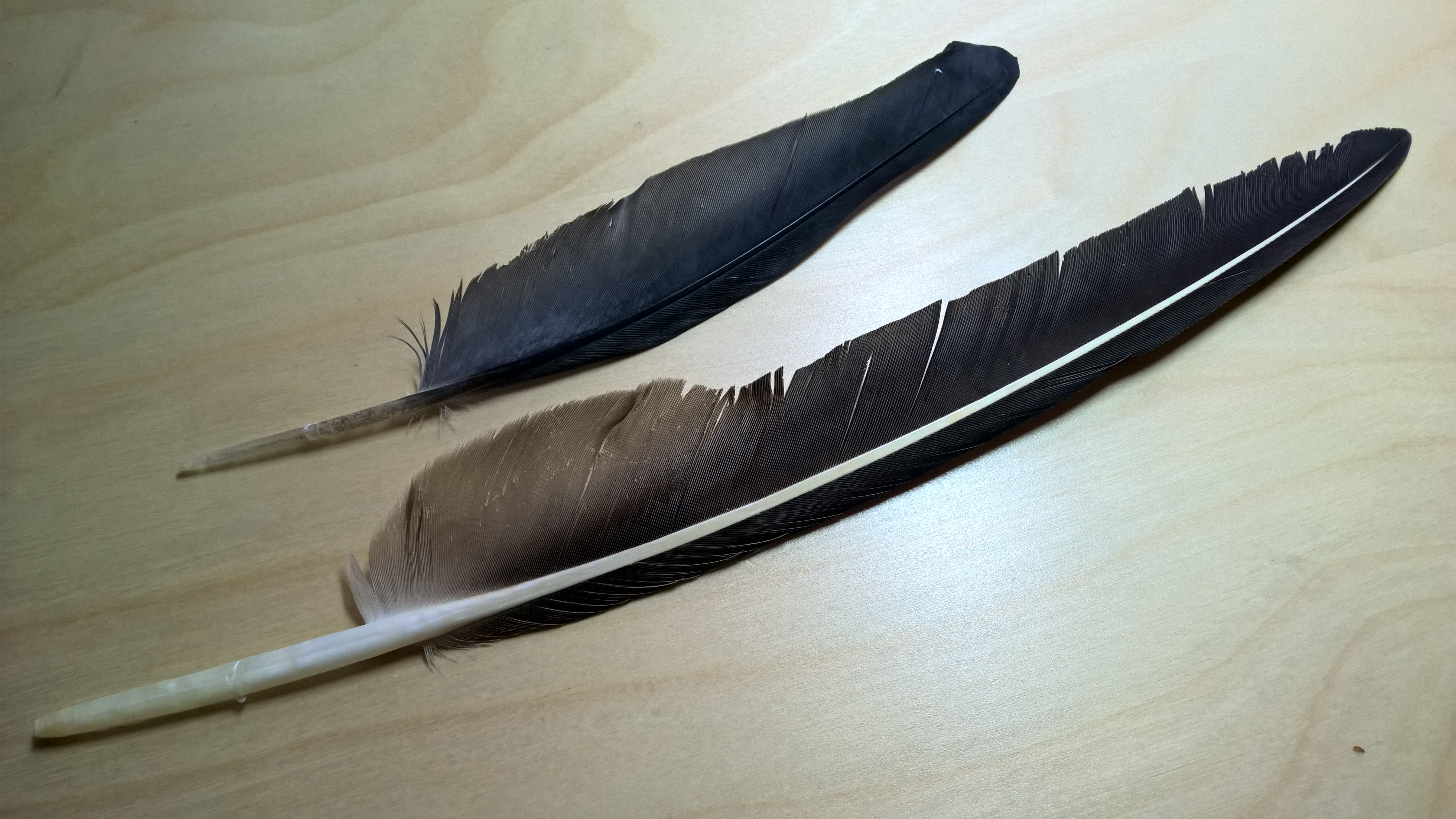
Feather of a Congo African gray parrot (top), with superior American feather

Feather of a Congo African gray parrot (top), with superior American bald eagle feather

To ensure a level playing field, I gave both quills identical nibs, carved according to the same half-remembered YouTube video. Both quills would copy the same line of text, the opening of Lord Timothy Dexter’s little book, A Pickle for the Knowing Ones (spelling courtesy of Lord Dexter). And both would employ the same media: Pelikan 4001 Fountain Pen Ink in violet — my go-to ink for purple prose — on Staples 110-pound card stock.

By a coin toss, the American bald eagle went first.
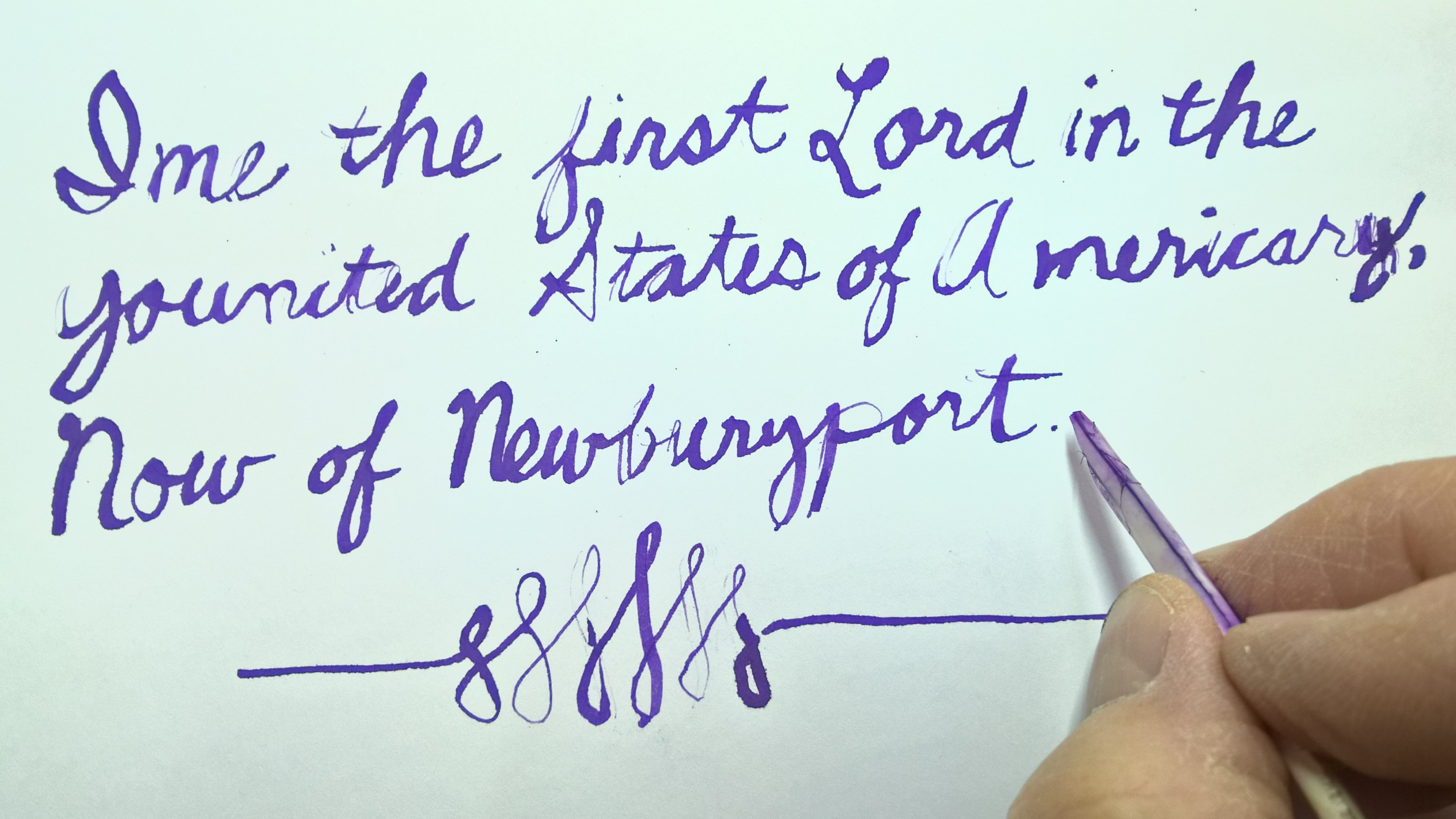
Quill of the American bald eagle

Quill of the American bald eagle

As the above image makes clear, the eagle delivered exactly the type of performance you’d want to see from the avian symbol of the United States: confident, slightly illiterate, and prone to guzzle ink by the gallon. Nice swagger, USA! Now let’s see if the chattering challenger can top that.
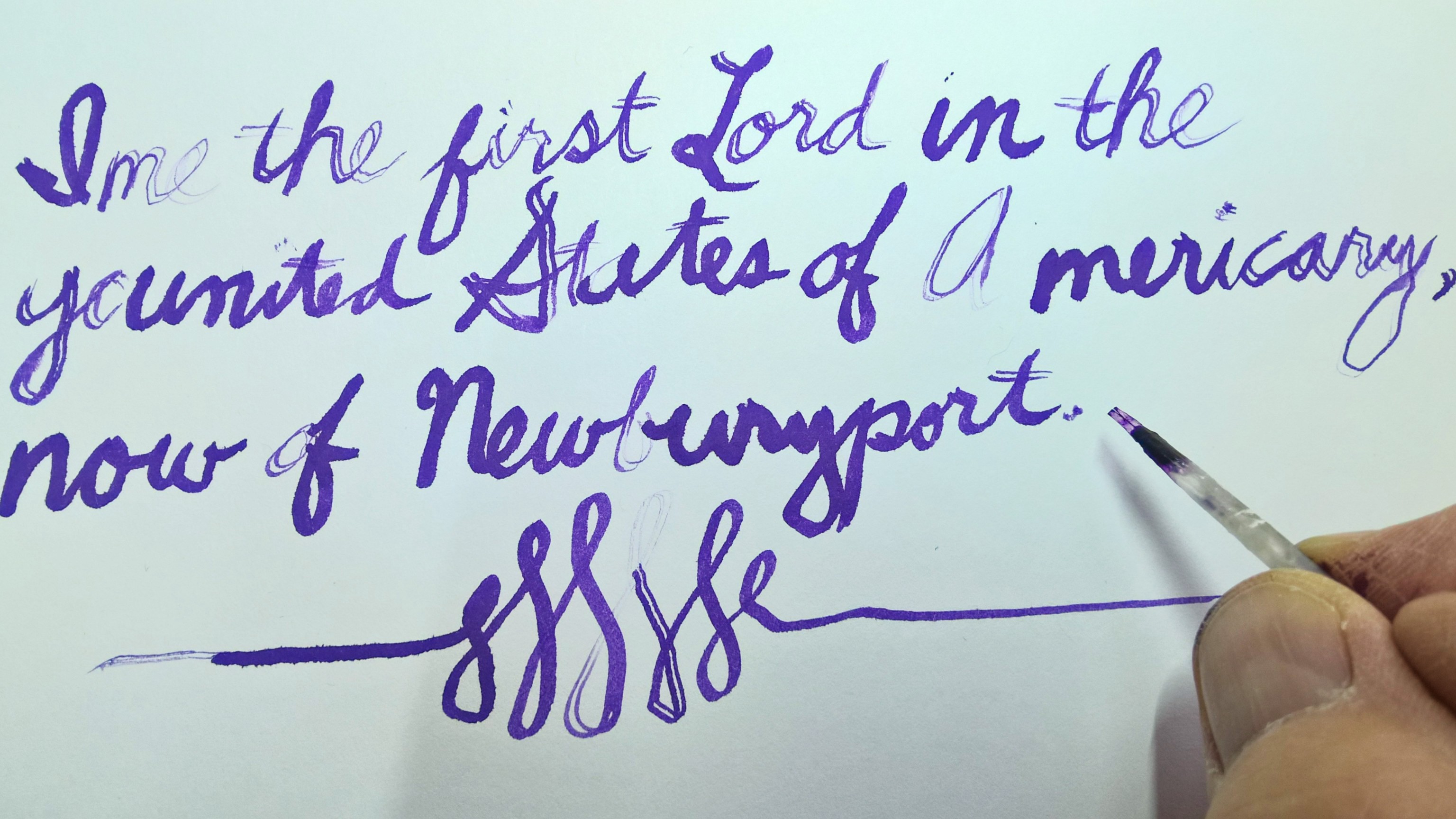
Quill of the Congo African gray parrot

Quill of the Congo African gray parrot

Aw, too bad. Those initials are bold enough, but everything else looks kind of wispy and intellectual. There’s no follow-through, as though Chimo’s heart just wasn’t in it.

In fairness to Congo African grays, it’s possible that John’s parrot did not volunteer his best plumage. Birds seldom do. In my dealings with American bald eagles, I always show the bird who’s boss. I see the quill I want (which, as I’ve noted before, is the second or third primary flight feather of the left wing), and I take it. Twist, tug, and gone. Usually, of course, I dangle a squirrel in front of the bird to distract it. I imagine an African gray would be similarly mesmerized by, oh, a little savory cracker and a morsel of soft cheese, or The News Hour with Jim Lehrer. We’ll have a rematch as soon as Chimo grows a pair.

Meanwhile, I’ll put my American eagle up against your Alpine swift, your Siberian crane, your Nubian bustard, whatever type of exotic feather you care to throw my way. But be forewarned: unless I completely misread the literary market, Americans want to buy books written with the quills of American birds. And that’s the only kind of quill I use.

Pardon my anachronism

11 Friday Sep 2015

Posted by davidbrittan in Tools of the trade

≈ 7 Comments

Tags

anachronism, Ngram viewer

Today I had to decide whether a dowager in 1801 would have been more likely to “draw near” or “draw nigh.” It was easy. I mean, really easy. A few years ago, when it was merely somewhat easy, I would have been forced to rely on the little voice inside me that whispered, “Come on, bonehead, only trashy romance novels have characters drawing nigh, usually as they unfrock their comely bosoms.” But today I found my answer by heading straight to Google Ngram Viewer.

Do you ever use this remarkable language tool? I generally get blank stares when I mention it to people. But it’s well worth experimenting with, even if you’re not a writer.

Ngram Viewer is a byproduct of Google’s mass absorption of the world’s published works, more or less from Gutenberg to the present. Billions of words and phrases from millions of books now reside in Google’s chronological database.

An ngram, which sounds like something out of Scientology, is a unit of language — where n is the number of words in the phrase you want to study. Type in your word or phrase, choose the language database you want to search (your options include British, American, and other flavors of English), and specify the time span you’re interested in. Google then looks at all phrases of similar length in all books and journals within your chosen period, and calculates the percentage of phrases that match yours. This is usually a tiny fraction of 1 percent, many zeroes past the decimal point and not illuminating in itself (unless the number happens to be straight zeroes — that tells you a lot). But when many such percentages are graphed over time, as happens in Ngram Viewer, you get a userful snapshot of the term’s frequency in print as it went in and out of fashion.

Ngram Viewer would have helped the Downton Abbey people avoid some verbal gaffes — like “get shafted,” a phrase we are to believe Thomas the footman would have uttered in 1918. Computer says: No. Not before the 1960s.

Get shafted ngram

You can trace several terms at once, as I did with “draw near” and “draw nigh,” to compare their fortunes over time. In publications from 1801, “draw near” was the clear favorite. Just as I suspected.

Draw near ngram

But one question still nagged me: Did I really want to use either of those phrases? They sounded so . . . prissy. I enlisted another cool Ngram Viewer feature: beneath the graph were links to the original publications, arranged by year, showing the context in which each phrase was used. Both terms, including the more popular “draw near,” were most common in fusty devotional texts: A Selection of Hymns from the Best Authors (1796), The Whole Works of the Late Rev. Mr. Ebenezer Erskine (1798), The Scotch Minister’s Assistant (1802). The little voice was right: “draw near” would have had an inch of dust on it even in 1801.

Would you like to know what my dowager did instead of draw nigh or near? She “trotted up the garden path,” of course.

Enter your electronick mail address to be inform'd of new posts.

Join 50 other subscribers

RSS Feed RSS - Posts

Subjects discuss’d herein

  • Book progress (3)
  • Dexter's image (1)
  • Items of questionable veracity (2)
  • Jonathan Plummer (3)
  • Quotations (4)
  • Timothy Dexter (3)
  • Tools of the trade (2)
  • Writers' tools (1)

Paid advertisement

Archives

  • September 2020
  • March 2017
  • November 2015
  • October 2015
  • September 2015

Blog at WordPress.com.

Privacy & Cookies: This site uses cookies. By continuing to use this website, you agree to their use.
To find out more, including how to control cookies, see here: Cookie Policy
  • Subscribe Subscribed
    • His Effing Nibs
    • Join 50 other subscribers
    • Already have a WordPress.com account? Log in now.
    • His Effing Nibs
    • Subscribe Subscribed
    • Sign up
    • Log in
    • Report this content
    • View site in Reader
    • Manage subscriptions
    • Collapse this bar
 

Loading Comments...